
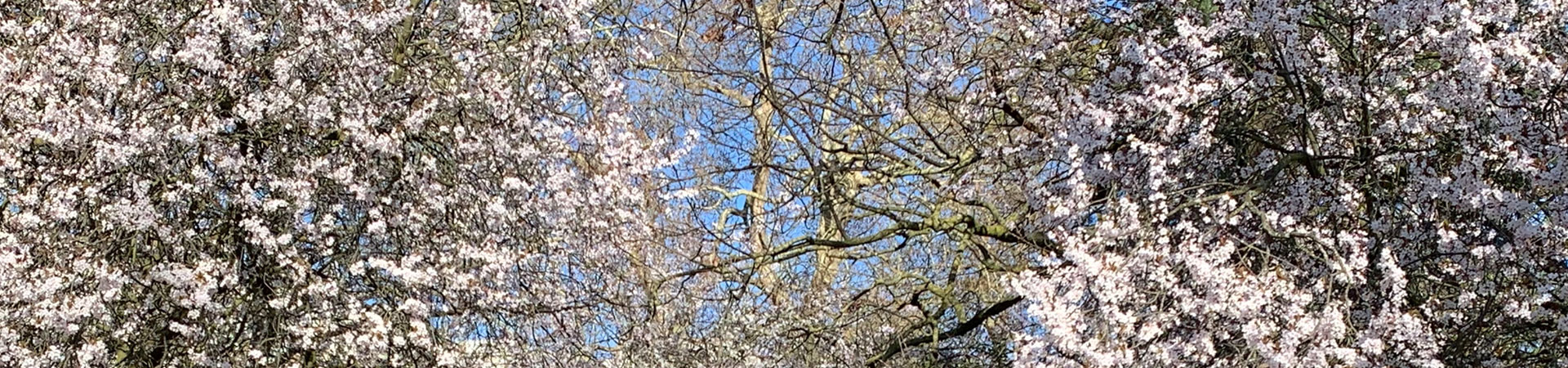
Blossom season arrives in Queen’s Park with a quiet kind of drama. I say quiet, however, this is not the case whilst walking down the road with my 9 year old excitedly pleading for me to shake blossom snow from low hanging branches. He likes the feel of the petals in his hair… but back to the aforementioned peaceful scene. One week the trees are bare, their branches still etched against the pale sky of late winter; the next, they are softened by clouds of pink and white, as if the world itself has exhaled. It marks a turning point—not just in the calendar, but in mood. Light lingers longer. Park benches fill. The rhythm of the park shifts. Yet blossom season is more than a visual spectacle. It is one of the most delicate and revealing moments in the urban ecological year—a brief window in which nature’s timing, resilience, and vulnerability are all on display.
The blossoms we admire—whether from ornamental cherries, plums, or apple trees—are not simply decorative. They are reproductive structures, finely tuned to seasonal cues. Temperature, daylight length, and even subtle soil conditions influence when buds open. In a stable climate, this timing aligns closely with the activity of pollinators such as bees and hover flies. The result is a synchronised exchange: nectar for the insects, pollination for the trees.
However, in recent years, that synchronicity has begun to shift.
Warmer winters and erratic temperature swings are causing many trees to flower earlier than they once did. While an early bloom might seem like a welcome sign of spring, it can create ecological mismatches. Pollinators may not yet be active in sufficient numbers, reducing successful pollination. A sudden late frost—still entirely possible in London—can damage blossoms, cutting short the reproductive cycle before it truly begins. In the parks and streets, these changes may be subtle, but they are meaningful. Urban green spaces are not isolated from broader environmental pressures; in fact, they are often magnified by them. Heat retained by buildings and paved surfaces can accelerate blooming, while air pollution can affect both plant health and insect populations for whom the blossoms provide refuge, as parks do for us.
Queen’s Park offers more than aesthetic pleasure during blossom season—it provides habitat. The trees support insects, which in turn support birds. Fallen petals enrich the soil, feeding microorganisms that sustain plant life year-round. Even small patches of grass or undisturbed corners contribute to a wider ecological network that stretches across the city.
For us residents, this makes the act of noticing more significant than it might seem. To pause beneath a flowering tree is to witness a living system in motion (or a 9 nine year old boy covered in snow). Recognise how dependent that system is on balance.
We can most definitely transform this simple awareness into simple action. Supporting pollinators, for example, does not require large-scale change. Planting pollinator-friendly species in gardens or balconies, avoiding pesticide use, and allowing sections of green space to grow a little wilder can all make a difference. Local councils, too, play a role by managing parks with biodiversity in mind—leaving deadwood where safe to do so, diversifying tree planting, and reducing chemical interventions. And we are so lucky that our area is teeming with communal actions such as these.
Blossom season also invites reflection on how we design and value our urban environments. Trees are often planted for visual impact, but their ecological function is just as important. So a pragmatic choice that is a win-win for everyone. A diverse mix of species can increase resilience against disease and climate stress, ensuring that future generations will still experience this fleeting display.
Perhaps what makes blossom season so compelling is its brevity. The petals fall almost as quickly as they appear, scattering across paths and lawns like confetti. There is a gentle melancholy in that transience, but also a reminder: natural cycles are ongoing, even as they change.
In Queen’s Park, the blossoms will fade, leaves will take their place, and our lovely area will move into its next phase of growth. But the questions raised during these few weeks linger longer. How do we protect the conditions that allow such moments to exist? And what responsibility do we carry, as daily users of these spaces, to ensure they endure? To walk through our local parks and streets during blossom season is to experience beauty—but also to glimpse the delicate balance that sustains it.
Climate Champion Ola Hudowska